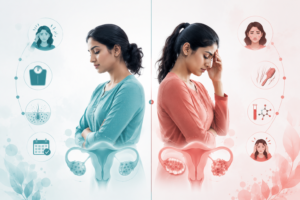
PCOD vs PCOS difference is one of the most Googled health questions by women in Hyderabad — and most of them are getting the wrong answer. The two conditions are used interchangeably everywhere including by some doctors but they are clinically different, they progress differently, and they require different treatment approaches.
Dr. Shalini Patlolla, DM Endocrinologist at Asian Diabetes Thyroid Hormone Super Speciality Center, Kukatpally and Madinaguda, sees PCOD and PCOS patients every week. This guide explains the difference in plain language so you know exactly what you are dealing with.
What Is PCOD?
PCOD — Polycystic Ovarian Disease — is a condition where the ovaries produce multiple immature or partially mature eggs due to hormonal imbalance. These eggs develop into cysts inside the ovaries, causing the ovaries to enlarge and produce excess androgens — male hormones.
PCOD is primarily a lifestyle-related condition. Poor diet, sedentary habits, stress, and hormonal disruption from environmental factors all contribute to it. This is why it responds well to lifestyle changes.
PCOD affects approximately 1 in 3 women of reproductive age in India. It is extremely common but also relatively manageable.
What Is PCOS?
PCOS — Polycystic Ovary Syndrome — is a more serious metabolic and endocrine disorder. In PCOS, the hormonal imbalance is deeper, the ovaries produce significant amounts of excess androgens, ovulation stops or becomes irregular, and the condition has direct links to insulin resistance, Type 2 diabetes, cardiovascular disease, and infertility.
In 2026, PCOS has been officially renamed PMOS — Polyendocrine Metabolic Ovarian Syndrome — by an international medical consensus to better reflect its metabolic nature and remove the misleading reference to “cysts.” This name change confirms what endocrinologists have known for years: PCOS is a systemic metabolic disorder, not just an ovarian condition.
PCOS affects approximately 1 in 5 women of reproductive age in India, with nearly 70% remaining undiagnosed.
The 7 Key Differences Between PCOD and PCOS
Difference 1 — Severity
PCOD is a milder condition. The hormonal imbalance is less severe and many women with PCOD can get pregnant naturally with minimal medical intervention.
PCOS is more severe. It involves deep hormonal and metabolic dysfunction that requires active long-term medical management, not just lifestyle changes.
Difference 2 — Cause
PCOD is primarily caused by lifestyle factors — poor diet, lack of exercise, stress, disrupted sleep patterns. Reversing these factors significantly improves PCOD.
PCOS has a stronger genetic and endocrine basis. While lifestyle helps, PCOS requires medical treatment alongside lifestyle changes. It is not reversible by lifestyle alone in most cases.
Difference 3 — Ovulation
Women with PCOD still ovulate regularly in most cases, just not every month. This is why fertility is only mildly affected in PCOD.
Women with PCOS frequently do not ovulate at all — a condition called anovulation. This is a leading cause of infertility and requires specialist intervention.
Difference 4 — Androgen Levels
PCOD causes mildly elevated androgens — enough to cause symptoms like acne and some facial hair, but not extreme.
PCOS causes significantly elevated androgens leading to severe hirsutism — thick facial and body hair — significant acne, scalp hair loss, and skin darkening.
Difference 5 — Effect on Fertility
PCOD has a mild impact on fertility. Most women with PCOD can conceive naturally or with minimal intervention.
PCOS has a significant impact on fertility. It is the leading hormonal cause of infertility in Indian women. Specialist-guided treatment is almost always needed for conception.
Difference 6 — Long-term Health Risks
PCOD, if left unmanaged, can progress to PCOS. It also increases risk of weight gain and insulin resistance over time.
PCOS carries serious long-term risks including Type 2 diabetes, cardiovascular disease, endometrial cancer (from irregular periods), metabolic syndrome, and depression. These risks make early diagnosis and treatment critical.
Difference 7 — Treatment Approach
PCOD responds well to lifestyle changes — 5 to 10% weight loss, regular exercise, a low-glycaemic Indian diet, and stress management. Medication may not always be needed.
PCOS requires a comprehensive treatment plan combining lifestyle changes, hormonal medication, insulin-sensitising agents like Metformin, and regular monitoring by an endocrinologist.
Symptoms — PCOD vs PCOS Side by Side
| Symptom | PCOD | PCOS |
|---|---|---|
| Irregular periods | ✅ Yes | ✅ Yes (more severe) |
| Weight gain | ✅ Mild | ✅ Significant |
| Facial/body hair | ✅ Mild | ✅ Severe |
| Acne | ✅ Mild | ✅ Moderate to severe |
| Hair loss (scalp) | ⚠️ Sometimes | ✅ Common |
| Infertility | ⚠️ Mild impact | ✅ Significant impact |
| Insulin resistance | ⚠️ Sometimes | ✅ Very common |
| Diabetes risk | ⚠️ Low-moderate | ✅ High |
| Depression/anxiety | ⚠️ Sometimes | ✅ Very common |
Why Indian Women Are at Higher Risk of Both
India has among the highest rates of PCOD and PCOS in the world. Several factors specific to Indian women increase risk:
- High carbohydrate diet — rice, roti, sweets — spikes insulin repeatedly
- Sedentary urban lifestyle especially in cities like Hyderabad
- Genetic predisposition — South Asian women develop insulin resistance at lower BMI
- Vitamin D deficiency — extremely common in Hyderabad despite the sun
- Stress from work and family responsibilities
According to research published in international journals, Indian women with PCOS have a 43% family history of Type 2 diabetes — far higher than Western populations. For more on this link, see research from NCBI on PCOS in Indian women.
Can PCOD Turn Into PCOS?
Yes. This is one of the most important things Indian women must understand about the PCOD vs PCOS difference.
If PCOD is left unmanaged — no lifestyle changes, no medical supervision, continued weight gain and insulin resistance — it can progressively worsen into full PCOS. This is why Dr. Shalini strongly recommends not waiting for symptoms to become severe before seeking specialist care.
Early intervention at the PCOD stage prevents the progression to PCOS in most cases.
Seeking Specialized Care in Hyderabad
Do not self-diagnose. If you want a clear clinical map of your pcod vs pcos difference, schedule an evaluation with the best doctor for pcos in hyderabad Dr. Shalini Patlolla.
.
How Dr. Shalini Diagnoses PCOD vs PCOS
Diagnosis requires more than just an ultrasound. Dr. Shalini uses a comprehensive workup:
- Pelvic ultrasound — ovarian assessment
- Complete hormone panel — LH, FSH, testosterone, prolactin, AMH
- Thyroid function tests — TSH, T3, T4 (thyroid problems commonly coexist)
- Fasting insulin and HOMA-IR — insulin resistance screening
- Blood sugar and HbA1c
- Lipid profile
This full picture allows Dr. Shalini to determine whether you have PCOD, PCOS, or a combination — and to design a treatment plan specific to your hormonal profile rather than a generic protocol.
For detailed information on PCOS treatment, visit our PCOD and PCOS service page or read our guide on PCOS and thyroid treatment in Hyderabad.
Book Your PCOD or PCOS Consultation in Hyderabad
Do not self-diagnose based on a Google search or an ultrasound report alone. Only a DM-qualified endocrinologist can properly evaluate the full hormonal picture and give you an accurate diagnosis.
Kukatpally Clinic
Clinic No. 286, Road No. 4, Beside Pulse Heart Centre, KPHB Phase I, Kukatpally — 500072
Monday to Saturday | 6:00 PM – 8:30 PM
📞 90000 30709
Madinaguda Clinic
H.No. 7-1/2, Above New Reliance Car Decors, Sri Durga Colony, Madinaguda Main Road — 500049
Monday to Saturday | 12:00 PM – 3:00 PM
📞 91335 52279