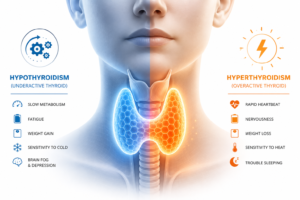
Hypothyroidism vs. Hyperthyroidism:
The thyroid gland is a small, butterfly-shaped organ located at the base of your neck, just below the Adam’s apple. Despite its compact size, it plays a massive role in regulating your body’s metabolism, energy levels, heart rate, temperature control, and hormone production.
When your thyroid functions normally, it produces thyroid hormones—primarily thyroxine (T4) and triiodothyronine (T3)—in precise amounts to keep your body operating smoothly. However, when the gland produces too few or too many of these hormones, your entire metabolism is thrown off balance.
The two main types of thyroid dysfunction are hypothyroidism and hyperthyroidism. While both involve the same gland, they are essentially opposite conditions.
In this detailed guide, we will break down the differences between an underactive and an overactive thyroid, including their causes, symptoms, diagnosis, and treatment options.
When comparing hypothyroidism vs hyperthyroidism, it is important to understand how thyroid hormones affect your body’s overall metabolism. An underactive thyroid in hypothyroidism slows down cellular energy production, whereas an overactive gland in hyperthyroidism forces your internal systems to work in overdrive. Identifying whether you have hypothyroidism vs hyperthyroidism allows healthcare professionals to tailor an accurate endocrine treatment plan for lasting hormonal balance.
1. What Is Hypothyroidism? (Underactive Thyroid)
Hypothyroidism occurs when the thyroid gland does not produce enough thyroid hormones to meet the body’s needs.
When hormone levels drop, your metabolism slows down. Think of it as a car engine running in low gear—everything in your body begins to operate at a slower pace.
Common Symptoms of Hypothyroidism
Because the body’s metabolic processes slow down, symptoms of hypothyroidism typically manifest as physical and mental fatigue:
-
Unexplained Weight Gain: Difficulty losing weight despite no change in diet or exercise.
-
Chronic Fatigue and Sluggishness: Feeling tired even after a full night’s sleep.
-
Cold Intolerance: Feeling unusually cold when others are comfortable.
-
Dry Skin and Brittle Hair: Thinning hair, dry scalp, and fragile nails.
-
Constipation: Slow digestion leading to infrequent bowel movements.
-
Muscle Weakness and Joint Pain: Stiff, aching muscles and joints.
-
Depression and Brain Fog: Difficulty concentrating, memory lapses, and low mood.
-
Slow Heart Rate (Bradycardia): A resting heart rate lower than normal.
-
Heavy or Irregular Menstrual Cycles: Menstrual changes in women.
Primary Causes of Hypothyroidism
-
Hashimoto’s Thyroiditis: An autoimmune condition where the immune system mistakenly attacks the thyroid gland, leading to chronic inflammation and reduced hormone production. This is the most common cause in developed nations.
-
Surgical Removal or Radiation: Surgery to remove part or all of the thyroid, or radioactive iodine treatment for thyroid cancer/hyperthyroidism, can lead to thyroid hormone deficiency.
-
Iodine Deficiency: Iodine is an essential mineral required to manufacture thyroid hormones.
-
Certain Medications: Drugs like lithium can interfere with thyroid function.
2. What Is Hyperthyroidism? (Overactive Thyroid)
Hyperthyroidism occurs when the thyroid gland produces an excess of thyroid hormones T3 and T4.
When thyroid hormone levels are excessively high, your metabolism accelerates significantly. Picture pressing the accelerator pedal down in a car while it’s parked—the engine revs dangerously fast, burning fuel rapidly and putting extra stress on internal systems.
Common Symptoms of Hyperthyroidism
An accelerated metabolism leads to hyperactive physical and emotional responses:
-
Unexplained Weight Loss: Burning calories rapidly despite an increased appetite.
-
Rapid or Irregular Heartbeat (Tachycardia/Palpitations): Feeling like your heart is racing or skipping beats.
-
Heat Intolerance and Excessive Sweating: Feeling overheated in normal temperatures.
-
Anxiety, Irritability, and Nervousness: Restlessness, mood swings, and difficulty relaxing.
-
Tremors: Involuntary shaking in the hands and fingers.
-
Frequent Bowel Movements: Accelerated digestion causing loose stools or diarrhea.
-
Sleep Disturbances: Insomnia or difficulty staying asleep.
-
Thinning Skin and Fine, Brittle Hair: Changes in skin texture and hair loss.
-
Bulging Eyes (Graves’ Ophthalmopathy): Swelling behind the eyes causing them to protrude (specific to Graves’ disease).
Recognizing the distinct physical warning signs of hypothyroidism vs hyperthyroidism can help you seek timely medical intervention. Patients suffering from hypothyroidism frequently report persistent weight gain, cold intolerance, and chronic fatigue, while those experiencing hyperthyroidism suffer from sudden weight loss, rapid heartbeat, and extreme heat sensitivity. Comparing hypothyroidism vs hyperthyroidism symptoms side by side makes it easier to track changes in your metabolic health.
Primary Causes of Hyperthyroidism
-
Graves’ Disease: An autoimmune disorder where antibodies stimulate the thyroid to overproduce hormones. It is the most frequent cause of hyperthyroidism.
-
Hyperfunctioning Thyroid Nodules: Non-cancerous lumps (toxic adenomas or toxic multinodular goiter) in the thyroid gland that independently produce excess hormones.
-
Thyroiditis: Inflammation of the thyroid gland that causes stored thyroid hormones to leak into the bloodstream.
-
Excessive Iodine Consumption: Consuming too much iodine through dietary supplements or medications.
3. Side-by-Side Comparison: Hypothyroidism vs. Hyperthyroidism
To help visualize the contrasts, here is a breakdown comparing the key aspects of both conditions:
| Feature | Hypothyroidism (Underactive) | Hyperthyroidism (Overactive) |
| Metabolic Speed | Slowed down | Accelerated |
| Weight Changes | Weight gain | Weight loss |
| Energy Levels | Fatigue, lethargy, drowsiness | Nervous energy, restlessness, insomnia |
| Temperature Tolerance | Sensitive to cold | Sensitive to heat |
| Heart Rate | Slower than normal (Bradycardia) | Faster than normal (Tachycardia/Palpitations) |
| Bowel Movements | Constipation | Frequent bowel movements / Diarrhea |
| Mood & Mental State | Depression, brain fog, apathy | Anxiety, irritability, panic attacks |
| Skin & Hair | Dry skin, thick/coarse hair | Warm/moist skin, fine/thin hair |
| Primary Autoimmune Cause | Hashimoto’s Thyroiditis | Graves’ Disease |
4. How Are Thyroid Conditions Diagnosed?
If you experience persistent symptoms of either condition, a medical evaluation is recommended. Diagnosis involves a combination of medical history, physical examination, and routine blood tests:
-
TSH Test (Thyroid-Stimulating Hormone): TSH is produced by the pituitary gland to tell the thyroid how much hormone to make.
-
High TSH usually indicates hypothyroidism (the pituitary gland produces extra TSH to stimulate an underperforming thyroid).
-
Low TSH usually indicates hyperthyroidism (the pituitary gland stops releasing TSH because hormone levels are already too high).
-
-
Free T4 and Free T3 Tests: Measure the active, circulating thyroid hormones in your bloodstream.
-
Thyroid Antibody Tests: Check for antibodies (such as TPO antibodies or TSH receptor antibodies) to determine if an autoimmune disease like Hashimoto’s or Graves’ is the underlying cause.
-
Thyroid Ultrasound or Scan: Used to inspect the physical structure of the gland for enlargement (goiter) or nodules.
Diagnostic blood testing plays a decisive role in distinguishing hypothyroidism vs hyperthyroidism. An elevated Thyroid-Stimulating Hormone (TSH) level paired with low Free T4 confirms a diagnosis of hypothyroidism, signaling that the pituitary gland is working overtime to stimulate a sluggish thyroid. Conversely, a suppressed TSH level combined with high Free T3 and T4 levels confirms hyperthyroidism, proving that circulating hormone levels are dangerously elevated.
5. Treatment Options
Both conditions are manageable with appropriate medical care under the guidance of an endocrinologist or primary care physician.
Treating Hypothyroidism
The primary goal is replacing the missing hormone to restore normal levels:
-
Levothyroxine (Synthetic T4): A daily oral medication that mimics the hormone your body isn’t producing enough of.
-
Monitoring: Regular TSH blood checks ensure dosage accuracy, as needs can change over time.
Treating Hyperthyroidism
Treatment focuses on slowing down hormone production or reducing thyroid tissue:
-
Anti-Thyroid Medications: Drugs like Methimazole or Propylthiouracil (PTU) block the thyroid from generating new hormones.
-
Radioactive Iodine Therapy: An oral treatment absorbed by the thyroid cells, gradually shrinking the gland and lowering hormone output.
-
Beta-Blockers: Medications used short-term to relieve rapid heart rate, tremors, and anxiety.
-
Surgery (Thyroidectomy): Surgical removal of part or all of the thyroid gland, typically reserved for large goiters, pregnant patients who cannot take medication, or thyroid nodules.
Summary
While hypothyroidism slows down bodily processes and hyperthyroidism speeds them up, both conditions impact your daily energy, mood, and overall well-being.
If you suspect your symptoms line up with either condition, consult a healthcare professional for a simple thyroid panel blood test. Early diagnosis and a tailored treatment plan can help rebalance your hormone levels and restore your quality of life.
Treatment strategies for hypothyroidism vs hyperthyroidism take completely opposite therapeutic paths. Managing hypothyroidism requires daily hormone replacement therapy using synthetic levothyroxine to raise deficient hormone levels. In contrast, managing hyperthyroidism involves reducing hormone production through anti-thyroid medications, radioactive iodine therapy, or surgery. Consulting an expert endocrinologist ensures your hypothyroidism vs hyperthyroidism treatment is safely adjusted based on routine TSH blood monitoring.